


The Hydrogen Scotland Student Poster Competition 2025 offers young researchers the chance to showcase their innovative research and solutions to the hydrogen community in Scotland. Hydrogen Scotland is excited to highlight your work at our annual conference, where it will be presented to industry leaders, researchers, and key stakeholders.
PRIZES:
- 1st Place: £300
- 2nd & 3rd Place: £150 each
- Winners will be announced at the conference awards ceremony dinner on Oct 28th at the Hilton in Glasgow
- All shortlisted authors can attend the conference and have posters on display on day 2 and also have the opportunity to network with Scottish and international hydrogen delegates
Competition Theme
- Theme for 2025: Enabling Scotland’s Hydrogen Economy: Integrating Production, Transportation, Storage, and Use at Scale (both domestic use and for exportation)
- Students are encouraged to present original research on scaling low-carbon hydrogen production, developing local supply chains, creating market demand, and identifying sustainable pathways for hydrogen export to international markets.
Competition Guidelines
- This year’s Hydrogen Scotland Student Poster competition is open to all post-graduate and post-doctoral students from any Higher education establishment in the UK. Please visit our members’ directory page to confirm your institution’s eligibility or write to us at info@hydrogenscotland.com
- We’re looking for your own ideas and creativity; any AI-generated or plagiarised content will result in disqualification
- All posters must be in PDF format, sized to A0, with text size no smaller than 10 pt in a standard font (Arial, Times New Roman, Calibri, etc)
- Each participant/group can submit only 1 poster
- Entrants must include their institution name, course and year of study with their submission
- Authors of shortlisted posters will be notified on the 18th of October. Authors must be willing to attend the Conference Dinner & Awards Ceremony on 28th October if invited and to present their posters at the Conference on Wednesday, 29th October. Attendance to the conference is free. For group entries, kindly nominate two students to act as representatives for your group at the conference.
To participate in the competition, please email your poster to info@hydrogenscotland.com by Friday, 26th September. Good luck to all the participants!
Our winners from 2024!
Eric Masuma Limoh, Heriot-Watt University, Edinburgh

Topic: Solar to H2 production in a decentralised energy system. Supervised by Professor Sudhakar Pitchaimuthu.
Eric Masuma Limoh is a passionate advocate for clean, resilient, and sustainable energy solutions. He holds a bachelor’s degree in chemical engineering from the Federal University of Technology, Minna, Nigeria, and has completed an MSc in global sustainability engineering at Heriot-Watt University, Edinburgh, Scotland. Eric’s commitment to exploring the role of hydrogen in decarbonising the planet and shaping energy futures stems from his deep interest in process optimisation, system modelling, fluid flow interaction, and fluid-structure interaction. His research focusses on the green hydrogen value chain and its practical implementation for a sustainable, low-carbon future.
Gift Udoh & Manuel Ojeda, Heriot-Watt University, Edinburgh

Topic: Digital twin for magnetic induction catalytic system (MagIC) for clean H2. Supervised by Professor Jon Andresen
Gift Udoh is a Master’s graduate of Global Sustainability Engineering from Heriot-Watt University and is currently pursuing a PhD in Green Industrial Futures at the same institution. Gift’s research focuses on the integration of digital twin technology with sustainable energy systems, particularly in clean hydrogen production.
With a strong interest in leveraging innovative technologies to tackle global energy challenges, Gift is passionate about contributing to the future of clean hydrogen production and advancing environmental sustainability.
Ruba Al Shabibi, University of Aberdeen

Topic: Techno assessment of membrane desalination technology for H2 production. Supervised by Professor Alf Martinez-Felipe
Ruba is a Senior Project Engineer with a deep passion for the environment, which drives her commitment to sustainable engineering practices. She has contributed to various energy projects at Point B, an environmental and engineering consultancy in Oman, focusing on project management, environmental auditing, environmental impact assessments, environmental management plans, and environmental engineering. She has collaborated with governmental entities to ensure compliance and effective project implementation. With a bachelor’s in civil and environmental engineering and a Master’s in Renewable Energy Engineering, she is dedicated to finding innovative solutions that protect and enhance the environment while promoting engineering excellence.
Read about our winners from 2023!
Students from across Scotland and the UK were encouraged to submit a poster for display at Hydrogen Scotland 2023. Students covered the need to ‘make it, move it and use it’, which broadly described the theme of Hydrogen Scotland 2023 i.e. the critical importance of joint activities as an enabler for scaling up clean hydrogen production and demand both in Scotland and across the North Sea region, how to enable growth; scaling up hydrogen production; and building the future.
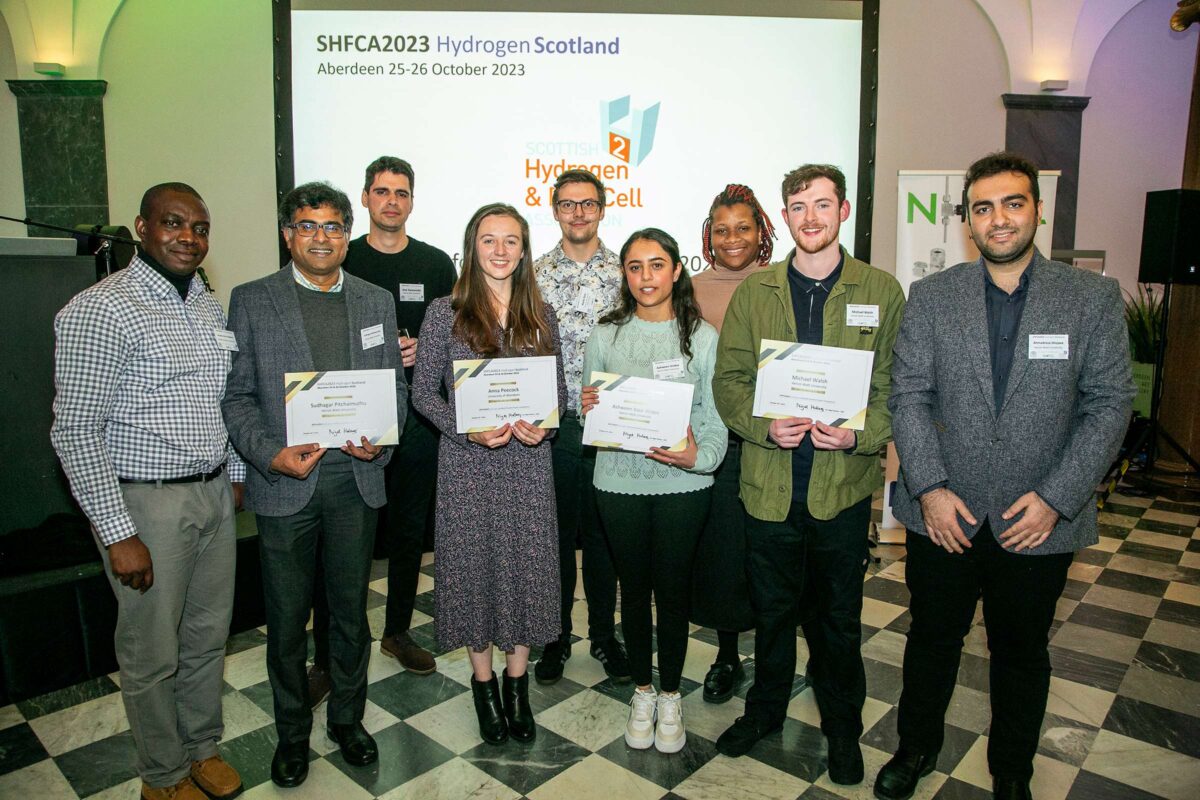
Ashween Kaur Virdee, a PhD research engineer at the Research Centre of Carbon Solutions at Heriot-Watt University, won the first prize for her work entitled CO2 and H2 conversion to sustainable electro-synthesised chemicals. She was supervised by Professor Mercedes Maroto Valer and Dr John Andresen.
Power-to-X is a growing interest in the search for means of decarbonising the chemicals industry. Ethylene (C2H4) is a key building block in the chemical industry, and “holds immense economic and industrial significance”. Conventional production methods emit ~3 kg of CO2 per kg C2H4 produced. Electrolysis allows for the conversion of renewable energy + captured CO2 to chemicals and energy vectors. Ashween’s work described the development and optimisation of an efficient and low-cost electrolyser for captured CO2 & H2 conversion to ethylene.
Michael Walsh, a PhD mechanical engineer also at the Research Centre of Carbon Solutions at Heriot-Watt University, won second place for his work on ‘Harnessing Whisky Wastewater for the Generation of Hydrogen by Electrolysis using Nanoscale NiSE Catalysts’. Michael was supported by Mercedes Maroto-Valer, John Andresen, Sudhagar Pitchaimuthu Ph.D., FRSC and Jeannie Ziang Yie Tan. His work was also supported by the Scotch Whisky Research Institute (SWRI).
He looked at whether the wastewater produced by Scottish whisky distilleries could be used as a feedstock in electrolysis. Michael and colleagues showed that hydrogen can be produced from whisky waste water but at a lower rate than when fresh water is used.
Anna Peecock, a Phd student at the University of Aberdeen won third place for her work on ‘Repurposing the National Transmission System for high pressure hydrogen distribution’. Her work was supported by Stuart Haszeldine Professor of Carbon Capture & Storage at The University of Edinburgh, National Grid ESO, the Edinburgh Climate Change Institute as part of the HyNTS Future Grid Programme.
Pipelines are the best economic prospect for large-scale, long distance hydrogen transport; hence opportunities to repurpose the existing gas grid for pure or blended hydrogen delivery are widely considered. It is therefore crucial that key leakage mechanisms are understood and their respective contribution to overall emissions quantified, in order to ascertain the environmental consequences of blending hydrogen into the natural gas stream. Hydrogen is considered an indirect greenhouse gas, as increased atmospheric concentrations have been shown to promote chemical reactions that result in increased lifetimes and abundances of gases that have a harmful climate impact. As such, it is essential to assess whether the introduction of hydrogen into the natural gas network to reduce downstream emissions could instead have negative environmental consequences, such that necessary mitigation strategies can be implemented.
Anna’s work sought to identify the most likely candidates for leakage within UK pipeline networks under current natural gas operation, and thereon quantify the associated environmental impact of introducing hydrogen into the existing network. Understanding this will ensure that appropriate regulatory policies can be put in place to ensure the potential for hydrogen, as a “green” alternative to natural gas, can be realised. The poster presents just a snapshot of the findings, estimating anticipated fugitive emissions upon conversion of the high-pressure transmission network for hydrogen service and the resultant global warming impact.
Our Judges for 2025

Natasha Madeira
Business Development Manager at the Energy Technology Partnership (ETP)

Iain Shirlaw
Strategic Consultant – Clean Energy & Biotech Investments

Dr. Katriona Edlmann
Prof. Sustainable Energy at the University of Edinburgh
Dr Katriona Edlmann is Professor of Sustainable Energy at The University of Edinburgh, with over 25 years researching the secure and sustainable utilisation of the subsurface for low-carbon energy applications including hydrogen energy and CO2 storage. Katriona is responsible for several UKRI, EU and industry funded projects investigating underground hydrogen storage technologies. Katriona currently serves on the UK Government Department for Energy Security and Net Zero Hydrogen Advisory Council Transportation and Storage Infrastructure Working Group and is sub-task lead on the International Energy Agency Technology Collaboration Programme underground hydrogen storage task

Professor Jon Clipsham
Director at Hydrogen Scotland
Jon is a proponent of hydrogen production from renewables, and was instrumental in the development of the global ‘first of a kind’ demonstration of an industrial scale prototype hydrogen economy in Orkney. Jon currently splits his time between academic / skills / training and industrial advisory / due diligence work through his own successful business – Hydrojon Limited – supporting start ups, project developers, investors, and government agencies internationally.


